
Map Guide
All Race Maps in Stumble Guys – Complete Overview
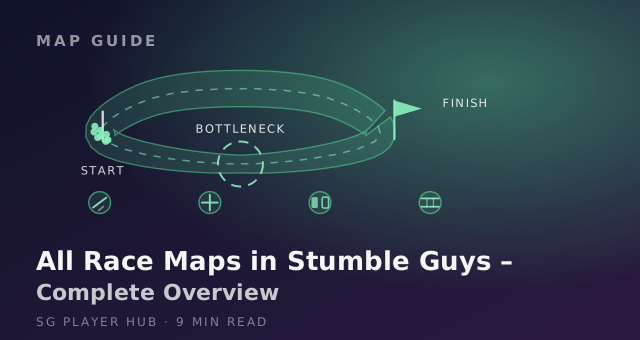
Key takeaways
- Race rounds reward route knowledge more than raw speed.
- Every race map has one bottleneck — find it and you gain places for free.
- The skills that carry over: late jumps, wide lines and dive saves.
Race rounds in Stumble Guys all ask the same question — how quickly can you get from the start to the finish without falling — but each family of rounds tests a different skill. Learn the shape of each route, find the point where the field gets squeezed, jump late rather than early, and hold your dive for the moment it actually saves you. The table and sections below cover the common race families and the habits that work across all of them.
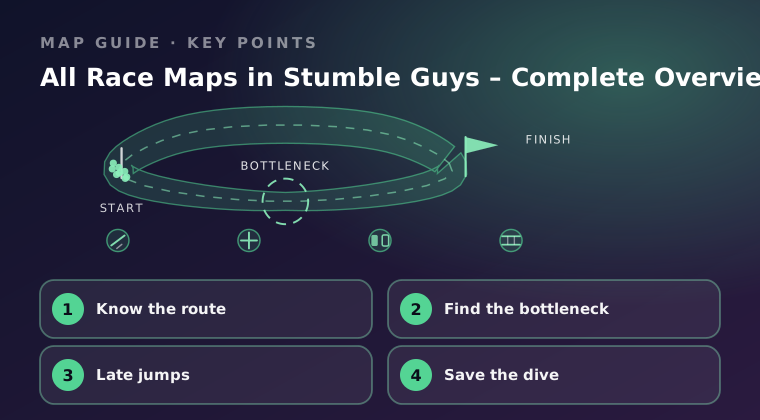
Know the route
Race rounds share a structure: an open start, a middle section with the real hazard, and a closing run to the finish. The start is for positioning, the middle is where races are won or lost, and the finish is where impatient players throw away a good run. Knowing which part you are in tells you what to spend your energy on.
| Round | What it tests | Hazard to expect |
|---|---|---|
| Slippery slope rounds | Steering while momentum carries you | Long slides that push you past the safe centre line |
| Rotating platform rounds | Reading a moving surface before you step on it | Platforms that turn you toward the edge while you wait |
| Moving-block climbs | Vertical timing and chaining one moving part to the next | Blocks that slide away in the middle of your jump |
| Narrow bridge sprints | Precision at speed on thin ground | Crowding that knocks you sideways with no room to correct |
| Disappearing tile dashes | Reading the floor while moving forward | Tiles that drop a beat after you step on them |
| Rolling ball chases | Pacing behind a moving hazard without stopping | Balls that sweep the full width of a narrow lane |
| Swinging hammer runs | Timing the gap between wide swings | Hammers that cover more of the lane than they look like they do |
| Conveyor belt sprints | Fighting a surface that pulls you backwards | Belt direction changes that break your line mid-section |
| Bumper corridors | Holding a line through repeated contact | Bumpers that fling you into the gaps at the side |
| Final sprint straights | Clean running and dive timing at the finish | A late dive that overshoots the finish line |
Read the table as a checklist. Before a round starts, name the family it belongs to and the hazard that comes with it. That single habit removes most of the surprise from the first ten seconds, which is where most race rounds are actually decided.
Find the bottleneck
Every race route has one place where the track narrows: a bridge, a single moving platform, a doorway, a corner that only fits two players. Identify it on the way in and plan to arrive there with space. Reaching the bottleneck inside the pack means you lose the race to somebody else's fall rather than your own.
- Look for where the track narrows or the number of usable lanes drops.
- Get in front of the pack before that point, or drop behind it — the middle of a bottleneck is the worst place to be.
- If you cannot get through cleanly, wait one cycle. A slow clean pass beats a fast collision.
- Take the wide side of the bottleneck even when it costs you a step.
When you are stuck behind a jam, stop pushing. Back off half a step, let the pile resolve, and take the gap that opens. Shoving into a jam on a narrow section sends both of you off.
Late jumps
Most race hazards move, and jumping early at a moving platform or a swinging obstacle means landing where it used to be. Wait for the part to come toward you, then jump into the closest, slowest part of its cycle. Late jumps land shorter, and shorter landings are easier to correct.
- Watch one full cycle of a moving part before your first jump at it.
- Jump as the platform arrives, not as soon as it comes into range.
- Use a short hop instead of a full jump when the landing area is narrow.
- On static gaps, do the opposite: commit early and fully, because hesitation shortens the jump.
Height matters too. If a jump feels marginal, take the higher launch point rather than a running start — a running start on a narrow ledge adds speed you cannot cancel mid-air.
Save the dive
The dive is the single most valuable tool in a race round. It covers more distance than a run, keeps your profile low under swinging hazards, and cancels bad momentum on ice. That is why it belongs to one specific moment, not to general speeding up.
- Hold the dive until you can see the landing spot.
- Spend it to cross a gap or to beat a closing hazard, never to go faster on open ground.
- Near the finish, dive only once you are straightened up, or you slide past the line.
- After landing a dive, stand up moving forward; stopping dead in a crowd invites a bump.
A dive saved is a corner you can afford to get wrong. Keep it until the round tells you which corner that is.
Final word
Race rounds reward preparation more than speed. Learn the route family, arrive at the bottleneck with space, jump late into moving parts, and keep the dive for the one moment it earns its keep. Put those together and your finishes stop depending on luck in the crowd.
Keep reading
Stumble Guys: Tile Fall Map Guide – Useful Tips
Tile Fall drops the floor out from under you. Learn the tile patterns, the safe timing and the movement habits that keep you standing longest.
How To Win On Spin Go Round in Stumble Guys
Spin Go Round is a rotating platform race. Use these route tips, timing cues and dive saves to reach the finish ahead of the pack.
Stumble Guys Bomb Drop Map Strategy Guide
Bomb Drop throws more than bombs. Read the spawn rhythm, control your lane and use these positioning strategies to survive the final seconds.