
Map Guide
Stumble Guys: Tile Fall Map Guide – Useful Tips
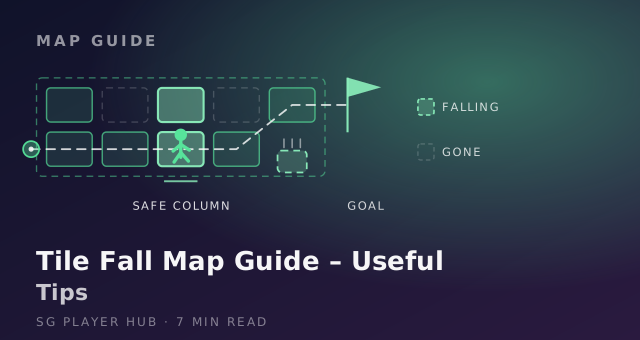
Key takeaways
- Stand near the middle of a cluster, not on the map edge.
- Move one tile at a time — long sprints cross gaps you cannot see.
- Watch the colour change; it fires before the tile drops.
Tile Fall is a survival round where the floor deletes itself while you are standing on it, so your result is decided by decisions made half a second before each hop. Read the tile colour before you commit, hold the middle of the platform, move a single tile at a time, and keep one spare tile picked out at all times. Do those four things in that order and the round becomes slow instead of chaotic.
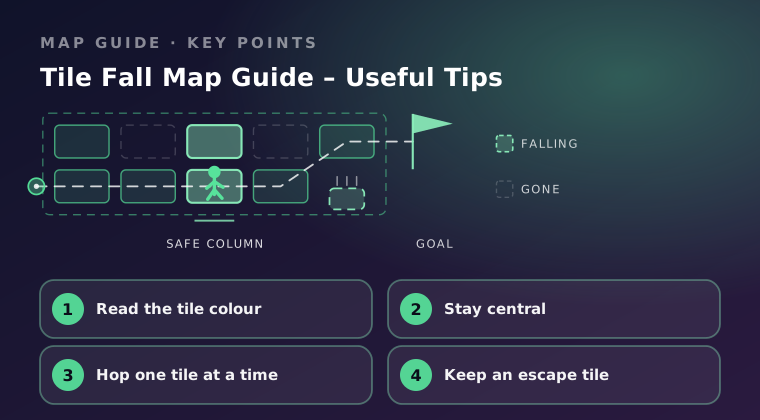
Read the tile colour
Every tile on this map runs through the same life cycle, and colour is the only signal you get about where in that cycle a tile currently sits. A tile in its resting colour is solid and will carry your weight. A tile that has shifted to the warning colour has already been triggered and will drop shortly after — sometimes immediately, sometimes after a beat, but always soon. Learn the pair once and you can read the whole floor at a glance instead of waiting for the tile under your own feet to move.
The mistake most players make is treating a changed tile as probably still fine, because somebody else is standing on it. Do the opposite. If the colour has shifted, that tile is gone as far as your plan is concerned.
- Scan two tiles ahead, not one: you need the destination and the tile after it.
- Never start a hop toward a tile that has already changed colour.
- Watch the tiles other players are standing on — their tiles change too, and that is free information.
- When two routes look equal, take the one with fewer warning tiles in the first three steps.
Recovery matters here too. If you land on a tile that changes under you, do not freeze and do not dive backwards toward where you came from, because that tile is usually the next to go. Take any adjacent resting-colour tile immediately, even if it costs you ground.
Stay central
Position matters more than speed. The centre of the floor is the only place where you have exits in every direction. Out near the rim you are one lost tile away from having nowhere to go, and corners are worse: two walls cut your options and the crowd pushes you into them.
After every hop, ask whether you are closer to the middle or closer to the edge. If you drifted outward, spend your next hop moving back in, even if the outer tile is still safe. Being central is cheap when there is no pressure and impossible to buy when half the floor is gone.
- Treat the middle third of the platform as home and return to it between hops.
- Never follow another player out to the rim — you inherit their dead end.
- If you are forced to the edge, travel along the rim rather than away from the platform, then cut back in at the first gap.
- Do not stand shoulder to shoulder with anyone; two players trigger tiles twice as fast.
Hop one tile at a time
Chaining jumps looks fast and reads badly. Every time you land you need a moment to read colour, and if you are already committed to the next jump you are reading the floor you are leaving rather than the floor you are arriving on. Land, settle, look, then step. One tile per decision.
Keep the jumps short as well. A full-power jump overshoots a single tile and puts you two out, on ground you never inspected. Use the smallest hop that clears the gap.
The one exception is a real hole. When a whole block of tiles has already dropped and you must cross it, the dive is the right tool: it covers more distance than a hop and lands you flat on the destination tile. Only dive when you can see that the landing tile is still in its resting colour.
- Land and let your character settle.
- Read the destination tile and the tile beyond it.
- Take the shortest hop that reaches a resting-colour tile.
- Re-check your position relative to the centre.
Keep an escape tile
Before you commit to a tile, name the tile you will take if this one fails. That habit is the whole difference between players who survive the first half of the round and players who survive the last ten seconds. An escape tile is not a route plan — it is one adjacent tile you have already checked, so recovery needs no thinking.
- Keep at least one tile of space between you and the nearest player.
- Prefer tiles with two or more resting-colour neighbours over tiles sitting in a narrow line.
- When a tile drops beside you, move to your named escape tile immediately, then re-plan from there.
- In the final seconds, stop trying to win ground — hold a pair of tiles and trade between them until the round ends.
If you do fall, watch the remaining players for one round instead of leaving. The tiles they avoid are usually the tiles that were about to go, which is exactly the timing you were missing.
Final word
Tile Fall rewards patience over speed. Colour tells you what is safe, the centre keeps your options open, single-tile hops keep your reads accurate, and a named escape tile turns a mistake into a step sideways. Practise the four habits in that order and the last ten seconds stop feeling like luck.
Keep reading

How To Win On Spin Go Round in Stumble Guys
Spin Go Round is a rotating platform race. Use these route tips, timing cues and dive saves to reach the finish ahead of the pack.
Stumble Guys Bomb Drop Map Strategy Guide
Bomb Drop throws more than bombs. Read the spawn rhythm, control your lane and use these positioning strategies to survive the final seconds.

Best Tips For Cannon Climb in Stumble Guys
Cannon Climb is a vertical race with moving parts. These tips cover the fastest lane, safe jumps and how to recover after a missed grab.