
Map Guide
Best Tips For Cannon Climb in Stumble Guys

Key takeaways
- Take the high lane early; it empties after the first thirty seconds.
- Jump at the end of a platform, not the start — you gain a full tile.
- If you fall, re-climb calmly: panic is what costs the second fall.
Cannon Climb is a vertical race where moving platforms, rotating bars and narrow ledges decide whether you gain height or lose it. The reliable line is to take the upper lane, jump late onto anything that moves, chain the moving parts together instead of stopping on each one, and treat every fall as a recoverable mistake. Here is how each habit works on the way up.
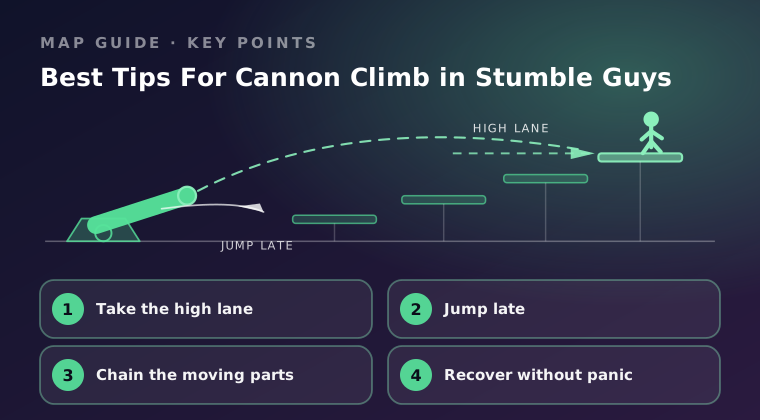
Take the high lane
Most of this course offers more than one line upward. The lower line is wider, so it looks safer, so everyone takes it — and you spend the whole climb fighting for space on a ledge. The upper line is narrower but usually empty, and an empty narrow ledge beats a crowded wide one.
Commit to the high lane early. Switching lanes halfway up costs more height than the lane saves, because the crossing points are the narrowest parts of the whole course.
- Pick the upper line at the first fork and stay on it.
- If another player is already on your ledge, drop in behind them rather than beside them.
- Do not change lanes because the lower one looks empty for a second.
- Give up a step of height to avoid a shoulder-to-shoulder pass; contact here costs you the section.
Jump late
On moving platforms, early jumps are the mistake. Players jump the instant a platform comes into range, and by the time they land it has moved on. Wait for the platform to travel toward you and jump as it arrives — the jump lands shorter and your margin for error is bigger.
Jumping late also means you can read where the platform is going. Watch one full cycle before you commit, the same way you would watch a sweeper arm, and step into the part of the cycle where the platform is closest and slowest.
- Let the platform come to you, then jump.
- Watch a full cycle before the first jump of any new section.
- Use a short hop rather than a full jump so you do not overshoot a narrow ledge.
- When two parts move in opposite directions, take the one travelling with you.
Chain the moving parts
The climb is built from linked moving pieces: platforms that slide, bars that rotate, sections that tip. Treat them as one continuous motion instead of a series of stops. Land, take a step to stay with the movement, then go again on the next beat. Standing still on a moving part feels safe and quietly carries you to the wrong end of it.
- Land on the moving part.
- Match its direction with a short hop or step.
- Read the next part while you are moving, not after you stop.
- Go again on the beat you identified before you landed.
Keep one beat of patience between parts. Rushing a chain is how you arrive at a ledge that has not reached you yet, and the correction afterwards costs more time than waiting would have.
If you lose the rhythm, stop on a static ledge and watch the section again. Re-reading a section costs a few seconds; guessing costs you the climb.
Recover without panic
You will get knocked off. The course is built so that a mistake sends you back a section rather than out of the round, and the players who finish well are the ones who take that reset calmly.
- After a fall, do not jump straight for the highest ledge you can see. Take the safe ledge, get your footing, then resume the chain.
- If you land on a lower lane, finish that lane to its junction instead of climbing diagonally across the course.
- While falling past a ledge, steer toward it — most falls here are catchable if you aim instead of flailing.
- Do not chase whoever knocked you off. You are racing the course, not them.
Final word
Take the high lane, jump late into anything that moves, keep travelling with the moving parts instead of stopping on them, and treat every fall as a short reset. Cannon Climb rewards players who read the course rather than try to outrun it.
Keep reading
Stumble Guys: Tile Fall Map Guide – Useful Tips
Tile Fall drops the floor out from under you. Learn the tile patterns, the safe timing and the movement habits that keep you standing longest.

How To Win On Spin Go Round in Stumble Guys
Spin Go Round is a rotating platform race. Use these route tips, timing cues and dive saves to reach the finish ahead of the pack.
Stumble Guys Bomb Drop Map Strategy Guide
Bomb Drop throws more than bombs. Read the spawn rhythm, control your lane and use these positioning strategies to survive the final seconds.