
FAQ
What is the best map for beginners in Stumble Guys?

Key takeaways
- Wide race maps with few moving parts are the best classroom.
- Avoid low-friction and rotating maps until your camera control is settled.
- Play the same map repeatedly — repetition teaches faster than variety.
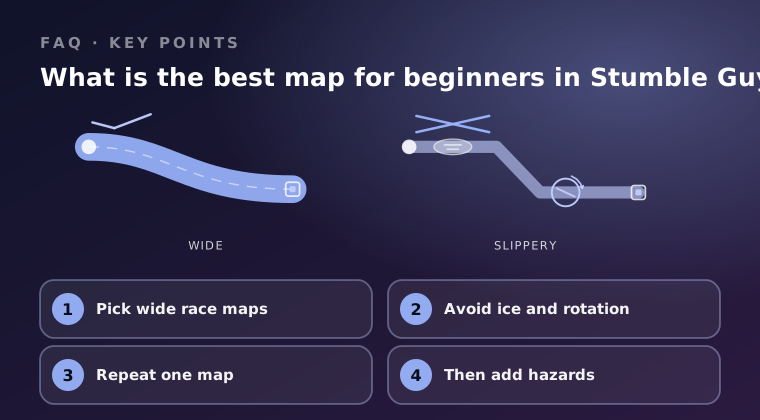
The best maps for new players are wide race courses with long straight sections and few moving hazards. Start on maps where falling costs time rather than the run, skip ice and heavy rotation maps until your movement is steady, and replay one course until you can finish it without a single fall.
Pick wide race maps
Width is the most beginner-friendly feature a course can have. On a wide track you have room to dodge, room to slow down, and room to recover when someone knocks into you. Narrow courses punish every small mistake, which is exactly what you want to avoid while learning.
- Look for courses built around running and jumping rather than balancing.
- Choose tracks with visible finish routes and no blind drops.
- Prefer rounds where a fall means losing seconds, not being eliminated.
- Avoid maps that funnel everyone through one gap; the crowd does the damage there.
If you can describe the route in one sentence, it is probably a good place to start.
Avoid ice and rotation
Two course families cause most early frustration: low-friction floors and fast-spinning obstacles. Both demand timing you have not built yet, and both turn a small error into a long recovery.
- Slippery floors punish full-speed running. Learn to tap and release instead of holding forward.
- Spinning bars and sweeping arms need you to read the sweep direction before committing.
- Falling tile sections are fine to watch, but do not expect to qualify while your movement is still shaky.
- Save these for practice runs where a loss does not bother you.
Repeat one map
Playing one course repeatedly teaches more than sampling twenty. Repetition builds the muscle memory for jump distance, dive timing, and where the crowd slows down.
- Pick a single wide race course and play it until you finish without falling once.
- Then try the same route at full speed and note where you lose control.
- Watch how other players handle the final section and copy the smoothest line.
- Only move on once your clean run feels boring rather than lucky.
That boring feeling is the signal. It means the movement is no longer something you have to think about.
Then add hazards
Add difficulty in layers. Each new hazard type should be the only new thing on the course, so you learn one lesson at a time instead of five.
- Step one: wide races with static obstacles.
- Step two: add moving parts that sweep slowly.
- Step three: add narrow sections where you must slow down.
- Step four: return to the slippery and fast-rotating courses you skipped earlier.
By the time you reach step four, your footing will be steady enough that the surface stops being the problem.
Final word
Start wide, stay away from slippery floors and fast spinners, and grind one course until a clean run feels routine. Then layer hazards back in one at a time. That order turns the hardest part of the game into the last thing you learn instead of the first.
Keep reading

How do you win consistently in Stumble Guys?
Winning consistently in Stumble Guys is about round selection and recovery, not raw speed. Here is what separates steady winners from lucky ones.

How to get free skins in Stumble Guys without paying?
You can earn Stumble Guys skins without spending money. Events, season tracks and challenges all reward cosmetics — here is where to start.

Does Stumble Guys support controller gameplay?
Stumble Guys controller support depends on your platform. Here is what works on mobile, PC and console, and how to set a gamepad up.