
FAQ
How do you win consistently in Stumble Guys?

Key takeaways
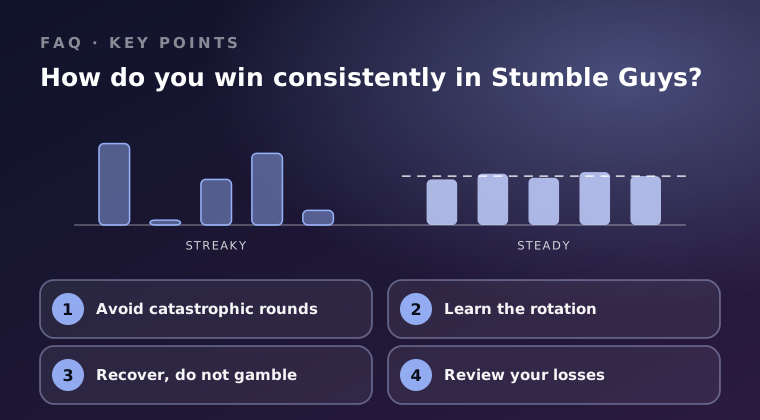
- Consistency comes from never losing a round badly, not from winning one.
- Learn the three or four maps that appear most in your region's rotation.
- Review the round you lost, not the match you won.
Consistent wins come from avoiding catastrophic rounds rather than winning every round. Learn each map's rotation, take the safe lane when the pack bunches, recover calmly after a fall instead of gambling on a shortcut, and review your losses to spot the one mistake that keeps costing you a qualification.
Avoid catastrophic rounds
A run ends the moment you fail to qualify, so your first job is to never have a disaster round. In early rounds the goal is simply to finish inside the cut, not to lead. Let other players fight for the front and take the lane with the most space.
- Start slightly off the centre line so a pile-up at the gate does not swallow you.
- On narrow bridges and planks, walk the edge and keep your dive in reserve for the last step.
- In crowd-heavy races, avoid the middle of spinning bars and swinging hammers; the outer lane is slower but far safer.
- If a section is jammed with players, stop and wait two seconds. Waiting beats being knocked into a pit.
Treat every early round as a pass or fail. A tidy fifth place is worth far more than a spectacular first place followed by an elimination.
Learn the rotation
Maps repeat, and almost every hazard runs on a fixed timing. Once you know the rhythm, you stop reacting and start planning. Spend the first seconds of a round watching rather than sprinting.
- Note where hazards start and which side they sweep first, then position on the trailing side.
- On tile and platform rounds, count the fall sequence once and commit to the pattern instead of improvising.
- Learn one safe route per map and one backup route for when the safe route is blocked.
- Remember the final round separately. Finals are short, so a single known shortcut matters more there than anywhere else.
You do not need every map memorised. Knowing the ten you see most often covers the large majority of your runs.
Recover, do not gamble
After a fall, the instinct is to sprint and make up the ground with a risky jump. That is how a bad round becomes a fatal one. Stabilise first: get back on the main path, regain your footing, and only then look for time.
- Use the dive to cross gaps, not to gain speed on flat ground. A mistimed dive costs more than the distance it saves.
- If you are clearly last in an early round, focus on finishing cleanly so you keep rhythm for the next round.
- Do not contest a narrow section against a crowd while behind. Take the wide way and let others crash.
- Keep your camera steady. Most recoveries fail because the player cannot see the next hazard while panicking.
Review your losses
Improvement comes from one honest question after each loss: which round ended it? Track that mentally for a session and a pattern appears within a few runs.
- Dying in round one means your start positioning and crowd handling need work.
- Dying mid-run usually means a specific hazard is beating you; replay that map and study its timing.
- Dying in the final means you need practice on the short maps, not on the long ones.
- Losing by a few places means you played safe too late; push slightly earlier in the next run.
Change one thing per session. Stacking five adjustments at once hides which one actually helped.
Final word
Winning consistently is mostly damage control. Survive the early rounds, learn the hazard timings on the maps you see most, stay composed after a fall, and review where each run ended. Do that and your qualification rate climbs long before your highlight reel does.
Keep reading

What is the best map for beginners in Stumble Guys?
Some Stumble Guys maps are far kinder to new players. Here are the friendliest maps to learn movement on and the ones worth avoiding at first.

How to get free skins in Stumble Guys without paying?
You can earn Stumble Guys skins without spending money. Events, season tracks and challenges all reward cosmetics — here is where to start.

Does Stumble Guys support controller gameplay?
Stumble Guys controller support depends on your platform. Here is what works on mobile, PC and console, and how to set a gamepad up.