
Mechanics
Advanced Movement Tricks You Should Learn
Key takeaways
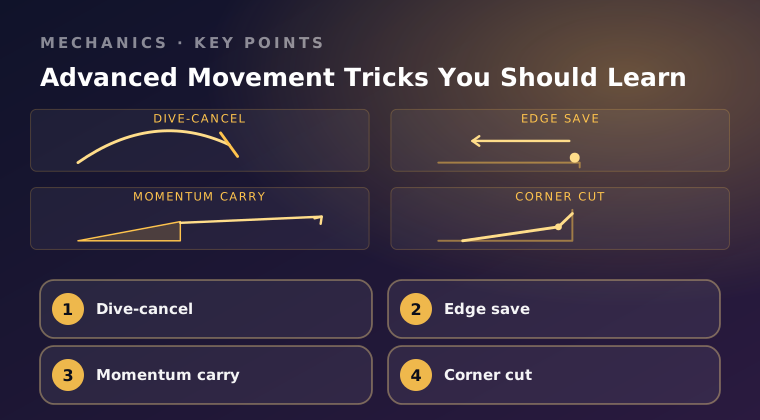
- Dive-cancel turns a long recovery into a short one — practise it on flat ground first.
- Momentum carries through turns; use it instead of fighting it.
- Corner cutting only pays when the shortcut has a floor.
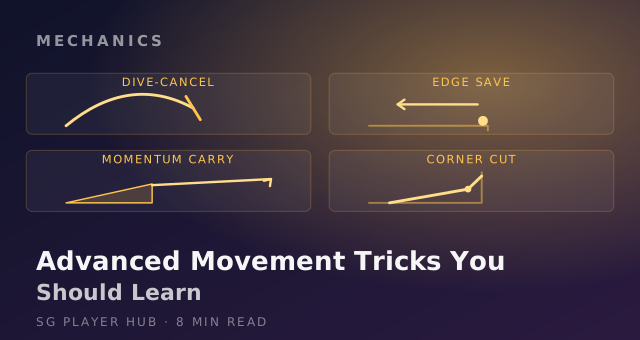
Once you understand the basic jump and dive, the next gains come from techniques that bend the recovery rules. Dive-cancel, edge saves, momentum carry and corner cutting are the four that show up constantly in high-level play, and each one can be trained on a single obstacle in ten minutes.
Dive-cancel
A dive-cancel is what happens when you use the dive landing itself to shorten the helpless recovery window. The trick is not magic: it is entering the dive from a sprint aimed at flat ground, so your bean slides rather than flops, letting you stand up sooner and keep your run going.
The input order matters. First reach full sprint on straight ground, second tap dive, third hold your stick forward through the landing so you do not roll sideways, fourth spam jump the instant you touch down to pop up into the next movement. Practising it slowly before trying it at speed saves you from learning the wrong muscle memory.
It pays on long flat straights between hazards and after a drop where you want to keep your top speed. It is genuinely bad right before a climb, a narrow beam, or any moment you need to stop immediately, because you are committed to travelling forwards.
Drill: find a flat straight with no obstacles, mark a start and finish line roughly three seconds of sprinting apart, and time yourself both ways. Once dive-cancel beats plain sprinting consistently over five runs, move it onto a real course.
Edge save
An edge save is the recovery of a jump or dive that came up short of a platform. You are falling towards the lip of a ledge, and instead of accepting the drop you convert it into a catch, keeping your run alive and sometimes gaining position on everyone who fell.
There are two versions worth learning. The first is the air adjustment: nudge your stick towards the platform throughout the descent, because tiny corrections during a fall add up to a body-length of horizontal travel. The second is the timing read: aim your arrival for the very front edge of the ledge, not the middle, since landing deep wastes the reach you earned.
This pays constantly on collapsing-tile rounds and any course with moving platforms, where a short approach is normal and falling means a long trip back. It is worth almost nothing on wide static platforms where missing the edge is not really possible.
Drill: pick one platform gap and deliberately undershoot it twenty times, aiming to catch the lip rather than land cleanly. Deliberate failure is the fastest way to learn where your grabbable range actually ends.
Momentum carry
Momentum carry is keeping speed through things that normally kill it: a turn, a small hop, a landing from a drop. Zero acceleration wastes far more time than most players realise, so preserving a little of it is often worth more than any single jump.
- Enter a fall already sprinting so the landing starts fast instead of from a standstill.
- Take jumps in a straight line; every mid-air swerve scrubs off speed.
- Avoid the habit of releasing the stick at the top of a jump; hold direction through touchdown.
The input order is simply sprint before the obstacle and hold through it, never neutral. This pays hardest on race rounds with long straights between hazard clusters, and it is nearly irrelevant inside crowded scramble sections where pushing matters more than pace.
Drill: run the same section twice, once normally and once forcing yourself to keep the stick fully forward through every landing. Compare your time across a fixed landmark and repeat until the two feel identical.
Corner cut
Corner cutting is taking the inside line around bends and around circular obstacles so you travel fewer metres than the player next to you. On looping and spiral courses it is quietly one of the biggest time saves available to you.
The technique is a wide entry, tight exit. Approach the bend from the outside edge, commit to the inside line at the apex, and let yourself drift wide again on exit while staying on solid ground. Wide-in means the inside line actually shortens rather than forcing you to slow down and fight the turn.
Practise it with a simple constraint. Pick a circular route on your chosen map, then run five laps hugging the inner edge and five running the middle of the path, timing both. The gap between those two numbers tells you exactly how much each lap is worth.
Final word
These four techniques share one principle: speed comes from controlling recovery and line, not from pressing more buttons. Learn dive-cancel for straights, edge saves for mistakes, momentum carry everywhere, and corner cuts on bends.
Keep reading
Stumble Guys Jump & Dive Mechanics Explained
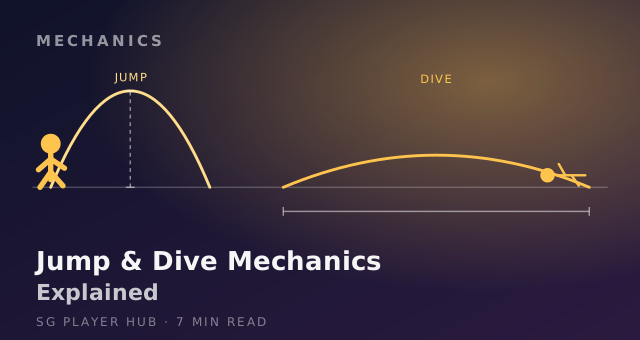
How jump and dive really work in Stumble Guys: distance, recovery, air control and the situations where a dive beats a jump every time.

How to Survive Longer in Elimination Rounds
Elimination rounds remove the slowest players. Learn the spacing, hazard timing and reset habits that keep you alive to the final whistle.
Best Strategies For Team Mode in Stumble Guys
Team mode scores the squad, not the player. Use these strategies for lane choice, revive timing and communication to carry a mixed team.