
Mechanics
Best Strategies For Team Mode in Stumble Guys
Key takeaways
- Split lanes on race rounds; stacking one lane wastes the whole squad.
- On survival rounds, spread out so one hazard cannot take the team.
- A safe fourth place helps the squad more than a risky first.
Team rounds are scored on the squad, not the individual, so the winning move is often the boring one. Spread your players across lanes, keep them apart on survival maps, take the guaranteed finish when points are tight, and communicate quickly. Here is how each of those looks in an actual match.
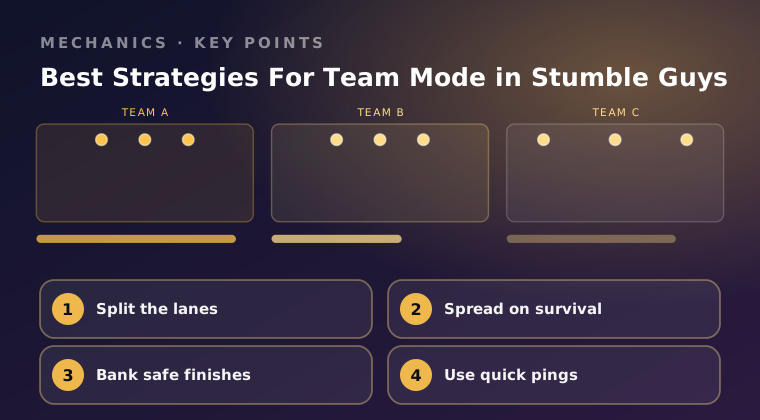
Split the lanes
On race rounds your team only needs a handful of beans across the line, so sending everyone down the same route wastes the whole squad. Lane choice should be decided before the countdown, not discovered halfway down the course.
- Give your strongest two players the fast, risky lane where the shortcuts are.
- Send your steadier players down the safe outside lane that always reaches the finish.
- Never stack two teammates on one obstacle; bodies collide and both lose time.
- Assign the centre lane to whoever recovers fastest from mistakes.
Splitting pays because hazards do not hit every lane equally. When one route gets blocked, the other two are still moving, and your score survives. This matters most early in a match, when a single bad crowd can wipe a stacked route.
Drill: before a race round, have everyone call their lane out loud, then run it three times holding that assignment regardless of how it goes. Judge afterwards whether the split saved you from one shared crash.
Spread on survival
On survival rounds, teammates standing together are a liability. A single hazard sweep or one panicking player can take out half your squad at once, and because scoring depends on how many of you last, clustered teams collapse fast.
Spread out to different sectors and stay there. Pick positions that do not share the same hazard sweep, and resist the urge to regroup after each wave — the middle of the map is where everyone else drifts and where most contact knockouts happen.
When one teammate is in trouble, do not dive in to help. Your job is to be the survivor who secures points, and rescuing usually converts one loss into two. Call out the risk instead and let them solve it.
Drill: assign each player a clock position at round start and forbid anyone from leaving their sector. Run it until the squad instinctively scatters rather than bunches after a scare.
Bank safe finishes
There is a difference between the fastest route and the one that reliably scores. When your team already has strong positions, the correct play is often to slow down and secure the finish rather than gamble on a shortcut that could lose several beans at once.
This is how you carry a weaker squad. If your teammates are struggling, your steady finish is worth more than a risky gamble for first place, because points from someone crossing safely always count while highlights sometimes end in nothing.
- Take the safe lane when the score is close and you are already ahead.
- Only gamble when trailing badly, where the upside outweighs the loss.
- Stop helping fallen teammates if it puts your own finish at risk.
- Count expected finishers, not potential ones, when judging whether to attack.
Drill: play five rounds where your only goal is finishing, ignoring placement entirely. Track your finish rate; once it approaches clean, start taking calculated risks again.
Use quick pings
Team mode rewards fast communication more than clever mechanics, but nobody has time for paragraphs mid-round. Agree on a tiny vocabulary beforehand so a single word lands instantly, and keep calls to what changes a decision.
- Name the hazard first, then the action: "bars left", "go right", "hold centre".
- Call your own status briefly: "down", "safe", "crossing".
- Give intentions before committing, so teammates can adjust lanes around you.
- Stay silent during hazard cycles; talking while counting breaks your own timing.
Drill: run one round where every call must fit in two words. The constraint forces clarity and reveals how much of your usual chatter carries no actionable information.
Final word
Team mode is arithmetic as much as skill. Cover the lanes, stay apart when the map tries to herd you together, protect guaranteed finishes, and keep calls short enough to act on before the next hazard.
Keep reading
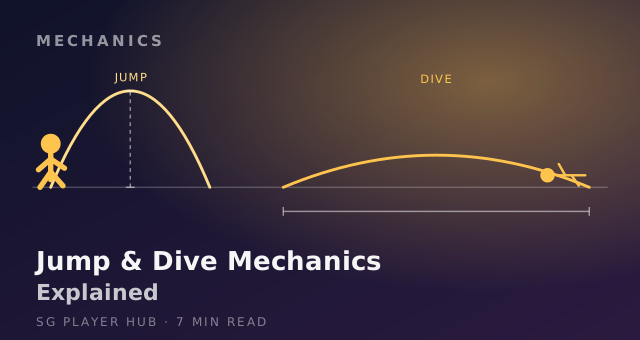
Stumble Guys Jump & Dive Mechanics Explained
How jump and dive really work in Stumble Guys: distance, recovery, air control and the situations where a dive beats a jump every time.
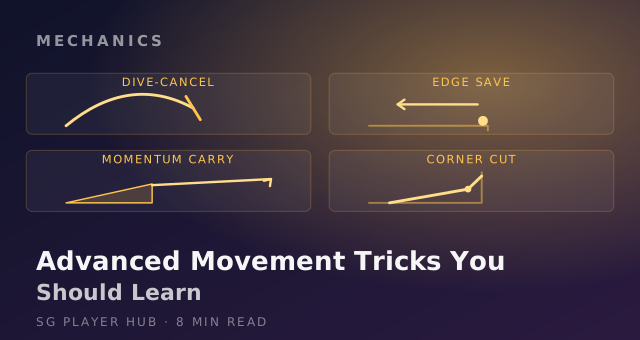
Advanced Movement Tricks You Should Learn
Advanced Stumble Guys movement: dive-cancels, edge saves, momentum carries and corner cuts that shave seconds off every race round.
How to Survive Longer in Elimination Rounds
Elimination rounds remove the slowest players. Learn the spacing, hazard timing and reset habits that keep you alive to the final whistle.